The International Court of Justice (ICJ) is calling for Member States to ramp up climate protection as an obligation to prevent significant harm to the environment after young Pacific Islanders sparked the move.
The decision bolsters the Paris Agreement, ozone layer treaties, the Biodiversity Convention, the Kyoto Protocol and makes it a State duty to regulate businesses on their emissions and anthropogenic greenhouse gas emissions. This includes limiting global warming to 1.5°C.
The ICJ urges States to cooperate in good faith to prevent harming the climate system and environments.
Additionally, when a State breaches its obligations, it is considered an internationally wrongful act that can result in legal consequences. This includes termination of the act, assurance of non-repetition, and full reparation to the injured State(s).
ICJ’s landmark Advisory Opinion from 23rd July is applauded and welcomed by several organizations, like Greenpeace, the International Union for Conservation of Nature (ICUN), and 350.org, for instance.
Argument for human right
Dr. Grethel Aguilar, IUCN Director General, said, “Climate change is not only a crisis of rising temperatures; it is a crisis for both humanity and nature with profound implications for human rights.”
“By undermining ecosystems, climate change weakens the life-support systems upon which people’s rights to life, health, food, water, and culture depend. As the global authority on the state of nature, IUCN urges all States to strengthen their commitments—recognising that protecting nature is not just part of the solution, it is essential to delivering climate justice and safeguarding our collective future.”
Anne Jellema, Chief Executive at 350.org, thanks the Pacific youth who chose to fight rather than drown, giving hope to their communities that are first in line to experience the effects of climate chaos.
“Years of shameful delays and diversions by world leaders have pushed humanity to a precipice, but today, the ICJ has made it clear that our governments are obliged under law to act, and act now. That starts with agreeing on a concrete timeline at COP30 to draw the line against the fossil fuels overheating the planet.”
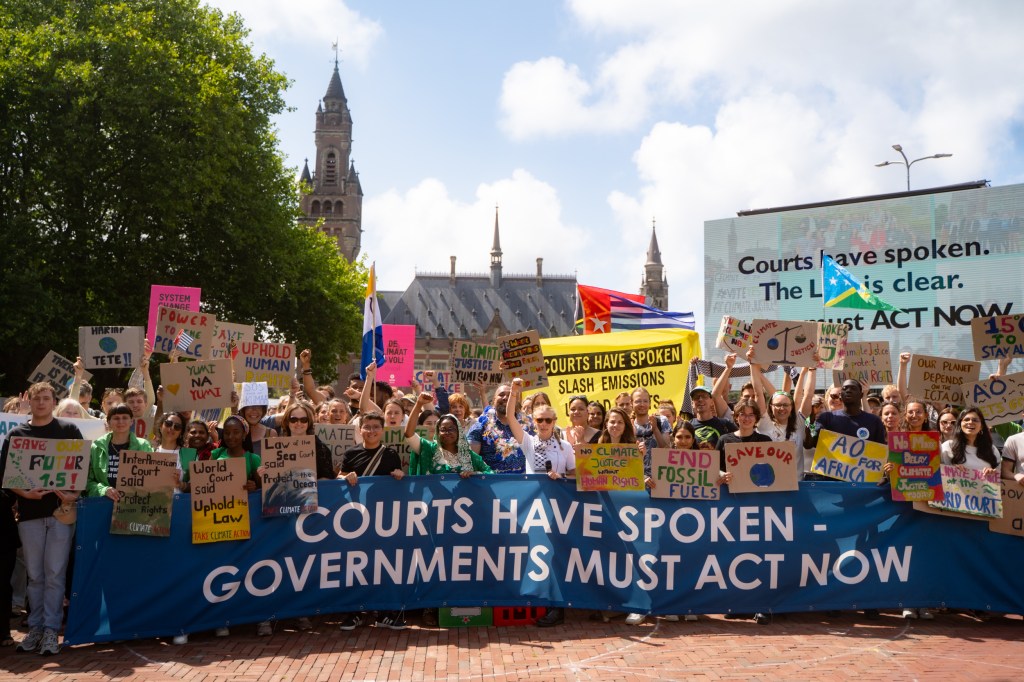
Fenton Lutunatabua, Deputy Head of Regions at 350.org, commented, “The oceans are rising, but so are we.”
“Today’s outcome adds strength to our fight for our future, placing our basic human rights at the heart of states’ climate obligations and setting a new legal and moral benchmark for climate action. The ICJ has upheld the call for greater accountability at this crucial time for our survival. A line has been drawn, and high-emitting states now have the obligation to address their climate responsibilities head-on.”
Danilo Garrido, legal counsel at Greenpeace International, believes that this moment is the beginning of a new era of climate accountability on a global level.
“This will open the door for new cases, and hopefully bring justice to those who, despite having contributed the least to climate change, are already suffering its most severe consequences. The message of the Court is clear: the production, consumption, and granting of licenses and subsidies for fossil fuels could be breaches of International Law. Polluters must stop emitting and must pay for the harms they have caused.”
Meanwhile, Flora Vano, a Vanuatu Women-Led community leader, said she will sleep easier. She feels that her people’s suffering and resilience have been recognized. “For the first time, it feels like Justice is not just a dream but a direction…Now, the world must act.”
Vanuatu on the frontline
The UN explains that Vanuatu wanted to seek an advisory opinion from the Court on climate change in September 2021, which inspired the youth group Pacific Island Students Fighting Climate Change. They sought to protect small island States from ecological catastrophes.
The country lobbied UN Member States in the 2023 General Assembly to gain support for its initiative. Vanuatu asked ICJ 1) What are the obligations of States under international law to ensure the protection of the environment? and (2) What are the legal consequences for States under these obligations when they cause harm to the environment?
The ICJ presented its answer in its latest Advisory Opinion this week.
In other moves to protect the environment, in May last year, elderly women’s group Verein KlimaSeniorinnen Schweiz sued the Swiss Government for “failing” to sufficiently protect the climate. Europe’s top human rights court ruled in their favour, paving the way for future means of holding governments accountable.
Although a victory for the planet, Symbiotic Futures critiqued that legal and governmental systems only work in favour of the environment when it concerns human rights, but not for the environment, natural world, or non-human animal rights in themselves.
 Symbiotic Futures
Leave a comment