Symbiotic Futures is driven by the ambition to form alternative modes of progress, away from anthropocentrism, Eurocentrism, and techno-utopian ideals.
Two new papers have introduced new indices to strive for an alternative and more hopeful future by the end of this century. Recognising the need to expand our visions of how progress is measured, one paper seeks to factor in all life on Earth. The other emphasises that current economic policies require a radical shift, one that addresses social wellbeing tensions that are being reinforced, in order to enable environmental and planetary solutions.
Mututally Beneficial Relationships
A global team of researchers has posited a framework to measure how well people and nature are thriving together, positing a new Nature Relationship Index (NRI) next to the Human Development Index (HDI). The NRI measurement can better track countries’ improvements in human relationships with the rest of life on Earth. It assesses how well countries are caring for ecosystems, including equitable access to nature and protecting them from harm.

The perspective in Nature calls for a need to rethink how we measure progress in terms of GDP and HDI, which are limited and do not factor in other lives on our planet.
“For decades, the human development approach has inspired global progress by focusing on people’s abilities to lead the lives they value and have reason to value: living longer, healthier lives with access to knowledge, and enjoying a decent standard of living,” says co-author Pedro Conceição, director of the UN Development Programme, Human Development Report Office.
“However, in the face of today’s dangerous planetary change, we must raise our ambitions, and that means envisioning progress and development to include healthy and mutually beneficial relationships with the living world.”
Lead author Erle Ellis, professor at the University of Maryland, Baltimore County, and Oxford Martin School Fellow at the University of Oxford, adds, “This isn’t the usual environmental messaging about limiting the damage or staving off disaster.”
“What we’re proposing is a shift from narratives of environmental harm and failure to stories and evidence that our societies have the capabilities to produce better futures for all life on Earth—and that in many ways we already have. By expanding human development to include healthy relationships among people and the rest of life on Earth, we hope to motivate whole new levels of collaboration and innovation across the planet.”
Human Wellbeing on a Finite Planet Towards 2100
A separate study explores two global future scenarios, one of gloom and the other of hope, and provides solutions to current economic policies that are hindering the hopeful scenario. The Earth4All Scenarios study names the two possibilities: Too Little Too Late and the Giant Leap.
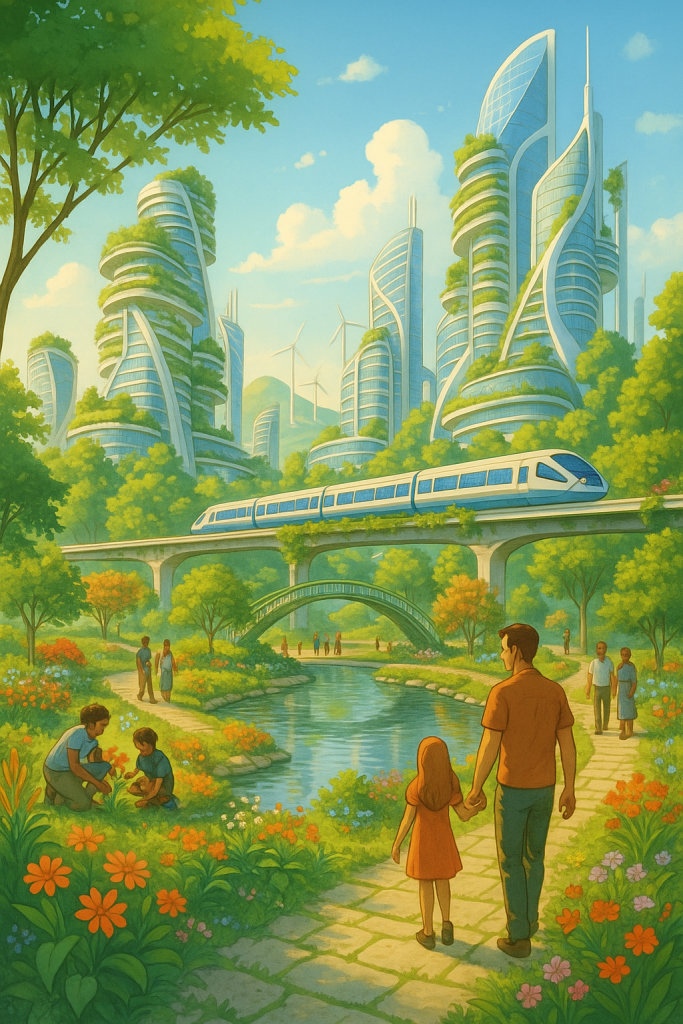
Too Little Too Late depicts a deteriorating world if business as usual continues. In contrast, the Giant Leap represents an opportunity for global action to reverse declining wellbeing trends, keep global warming below 2°C, reduce inequality, and create prosperity.
The researchers of this paper believe that human society and wellness issues must be resolved and can be within planetary boundaries. They were driven by finding solutions to wellbeing for all while reducing risks of destabilising the biosphere.
Social Tension and Wellbeing indices
The paper in Global Sustainability provides policy recommendations to the 2022 published Earth for All: A Survival Guide for Humanity. It presents five “extraordinary turnarounds” that could end poverty, reduce inequality, empower women, and transform global food and energy systems. For this to become reality, researchers urge radical changes to current economic policies at a coordinated global level.
Researchers introduce two new indices: social tension and wellbeing to track societal progress this century. They model interactions between economic, environmental factors, and especially social feedback loops that factor in trust, public investment, and political capacity. The results suggest inequality and environmental degradation fuel social tensions, reducing governments’ ability to implement policies linked to climate and planetary boundaries.
“By integrating a social tension index and a wellbeing index, we have been able to highlight the importance of social dynamics in climate scenarios,” explains co-author Nathalie Spittler of BOKU University.
“Achieving climate goals is not just a question of technological and economic developments. If wellbeing declines and social tensions rise, this creates a negative feedback loop where the very conditions needed for transformational change become harder to achieve.”
The study underlines actions that reduce inequality and increase social cohesion and wellbeing are key to implementing policies on climate and other urgent global issues.
“The modelled wellbeing index illustrates that it is possible to gain an understanding of wellbeing that is compatible with global dynamics taking place in an integrated systems model,” reads the paper.
“While for this analysis the chosen index conceptualises wellbeing through five distinct components of individual, societal, and nature wellbeing, it is possible to also investigate other indicators, such as the Human Development Index or the Sustainable Development Goals. The exercise also highlights the need to endogenise relationships between the human world and biophysical Earth in order to design policies for societal transformations.”
“The Giant Leap scenario shows we have is technically plausible, but ambitious path forward,” comments lead author Per Espen Stokens of BI Norwegian Business School. “It requires a level of international cooperation and political leadership we have yet to see, but such a political shift could still deliver a thriving future for humanity on a stable planet.”
The paper cautions, “It is crucial to mention that although the long-term future always is terra incognita, the further that critical planetary boundaries are transgressed, the less predictable the world is becoming.”
Written by Venya Patel.
 Symbiotic Futures
Leave a comment