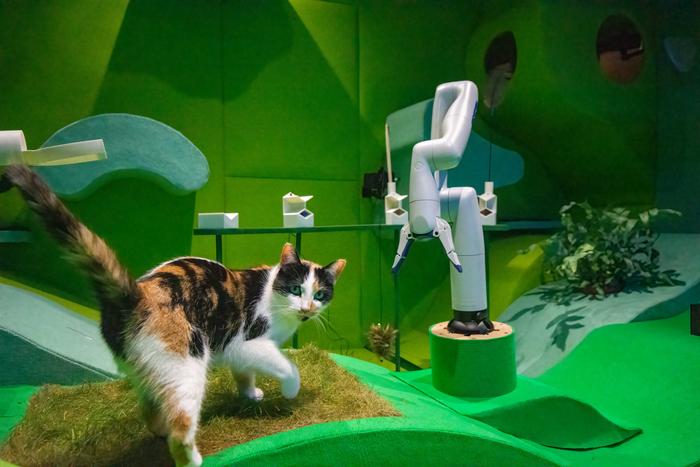
University of Nottingham researchers and artists at Blast Theory collaborated to create a “multispecies world,” in which three cats and a robot arm coexisted, enclosed for at least 6 hours a day across 12 days.
Published this month, the paper “Designing Multispecies Worlds for Robots, Cats, and Humans” shows how designing technology and its interactions are insufficient to care for cats. It underlines the importance of equally considering the “world” in which the technology operates.
The research emphasises the importance of human involvement in animal welfare.
According to the paper, robots are integrating into daily lives in the ways humans clean homes, mow lawns, deliver shopping, and move items in hospitals. Companion animals in human homes and others in cities encounter robots.
“Often these encounters will be unplanned and secondary to the robot’s intended task, for example cats riding Roombas, guide dogs being confused by delivery robots, or hedgehogs having to navigate in a world inhabited by lawn mowing robots,” outlines the paper.
“However, they could also be intentional. We could design robots to serve animals too. Despite the inevitability of such encounters, planned or otherwise, little is known about how to design robots for animals. Can we even trust them with each other?”
Perhaps the question should extend to, should robots be designed to evoke trust?
Opinion
While I am no engineer or designer, this research raises intriguing questions about how we can design and build worlds that respect both human and non-human relationships in interaction with AI systems and technology.
Often, designs in human-built societies are not friendly to non-human creatures. For instance, sliding doors that trap birds indoors or large gutters that small animals can fall into are simple examples that come to mind.
The research team is considering how to design robots for animals, an essential step away from anthropocentric designs. In the case of robot design, should the robot be modeled as an arm? Why not a human or cat figure? Perhaps it does not need to resemble a living form at all. Scientists could create various models for the cats to choose from, revealing the cats’ preferences.
Cats might trust based on smell rather than appearance. It is challenging to understand how cats decide to trust one thing over another. Is positive reinforcement, such as giving treats and playing enough to build trust, or does it simply make them reliant on the robot?
Trust must imply an emotional connection. I know I will be greeted by daylight each morning, but this is reliance, not trust. Similarly, I rely on my Roomba to vacuum the floor, but there is no emotional connection.
Philosophically, trust is contested. Does it involve mere optimism that the trustee will act as expected, or does it also involve certain beliefs, attitudes, emotions, or motivations on the part of the trustee, such as goodwill?
Do creatures like cats need to trust robots? If robots are designed to evoke affection and attachment, perhaps trust becomes important in their relationships.
Should robots for companions be designed to evoke trust? How might this be achieved?
Training Trust
The installation involves a playful robot arm that aims to make cats happier, such as dragging a mouse toy on the floor, swishing feathers into the air and offering treats.
Researchers trained AI to learn favourite games liked by cats best so it would personalise the cat’s experience.
“At first glance, the project is about designing a robot to enrich the lives of a family of cats by playing with them,” comments Professor Steve Benford from the University of Nottingham, who led the research, “Under the surface, however, it explores the question of what it takes to trust a robot to look after our loved ones and potentially ourselves.”
The research was recently presented at the Computer-Human Conference, winning best paper.
Designing Machine Ecologies
The team designed the robot based on insights into what each individual cat liked and found exciting, while also designing the world in which the cats and robot lived. It included safe spaces for cats to examine the robot.
“The cats did not appear to get bored, but rather to become confident, even assertive, in engaging the robot in such play,” reads the paper.
Eike Schneiders, Transitional Assistant Professor in the Mixed Reality Lab at the University of Nottingham, who worked on the design, says, “As we learned through Cat Royale, creating a multispecies system—where cats, robots and humans are all accounted for—takes more than just designing the robot.”
“We had to ensure animal wellbeing at all times, while simultaneously ensuring that the interactive installation engaged the (human) audiences around the world. This involved consideration of many elements, including the design of the enclosure, the robot and its underlying systems, the various roles of the humans-in-the-loop, and, of course, the selection of the cats.”
The paper suggests that bringing robots into homes to care for loved ones will require its interior redesign.
In Trust We Rest?
Though the question of trust remains unresolved, it is crucial to consider the underlying values that can form between humans and non-humans, humans and humans, and non-humans and non-humans.
Is trust a missing link in creature-robot relations? Trust may be essential for deeper emotional connections and better coexistence between animals and robots.
Written by Venya Patel
 Symbiotic Futures
Leave a comment